Matthews Gets More Rain Than You Might Expect
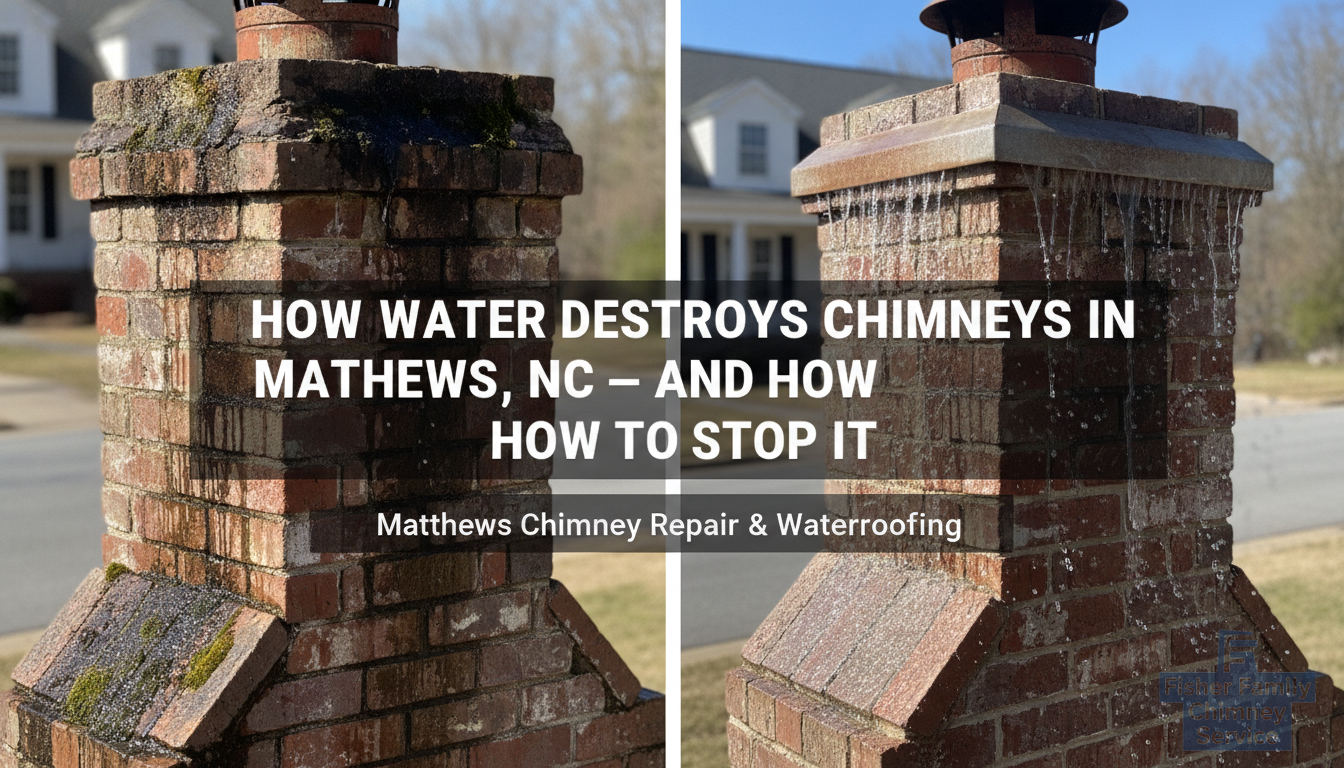
The Charlotte metro area — including Matthews, Mint Hill, Indian Trail, and surrounding communities — receives an average of roughly 43 inches of rain per year, well above the national average. Add in the region's winter freeze-thaw cycles, where temperatures regularly dip below 32°F and then rebound within the same week, and you have conditions that are particularly hard on masonry chimneys. Water enters the chimney system, expands when it freezes inside the masonry pores and joints, and physically fractures the brick and mortar from within. Over time, what started as a hairline crack in the crown or a slightly recessed mortar joint becomes a significant structural and moisture problem that reaches deep into the chimney and sometimes into the home itself.
The good news is that water damage to chimneys is almost entirely preventable when the right protective measures are in place. Fisher Family Chimney Service offers a complete suite of moisture protection services — from chimney cap and crown repair to tuckpointing and mortar repair to professional chimney waterproofing — designed to work together as a system that keeps water out at every entry point.
How Water Enters a Chimney: Five Common Entry Points
Understanding where water gets into your chimney is the first step toward stopping it. Here are the five most common entry points our technicians find during chimney inspections throughout the Matthews area:
- The chimney crown: The mortar or concrete slab that caps the top of the masonry chimney is exposed to full weather and thermal stress year-round. Cracks in the crown funnel water directly onto the top of the masonry and around the flue tiles, where it saturates the chimney from the top down.
- The chimney cap (or its absence): Without a properly fitted cap, rain falls directly into the open flue. This rusts the damper, saturates the smoke shelf, accelerates liner deterioration, and allows freeze-thaw cycling inside the flue itself. Many homes in established Matthews neighborhoods have older chimneys with missing or deteriorated caps.
- Mortar joints: The mortar between your bricks is more porous than the brick itself and weathers faster. As joints crack and recess, they become channels that draw water deep into the masonry core by capillary action.
- The brick face: Masonry brick is porous by nature and absorbs water directly through the face. In older or unpainted chimneys, the entire exterior surface acts as a sponge during a rain event.
- Flashing failures: The metal flashing where the chimney meets the roofline is designed to create a watertight seal, but caulk deteriorates and flashing can pull away from the masonry over time, allowing water to run down the chimney exterior inside the roof structure.
The Damage Water Causes — Level by Level
Water that enters the chimney system does not stay in one place. It migrates through the masonry, following gravity and capillary paths, and causes damage at multiple levels simultaneously:
- At the crown and top of the chimney: Initial cracks widen with each freeze-thaw cycle. Chunks of concrete begin to break away. The structural connection between the flue tile and the surrounding masonry weakens.
- In the masonry body: Saturated brick faces begin to spall — the surface layer literally pops off as trapped water freezes and expands. Mortar joints erode further, and the masonry structure loses cohesion. Efflorescence — the white salt deposits you may have noticed on your chimney — is a visible sign that water is migrating through the brick and carrying dissolved minerals to the surface.
- At the flue liner: Water that reaches the terra cotta tiles of an older liner accelerates cracking and joint separation. Once the liner is compromised, combustion gases including carbon monoxide can bypass the flue and enter the home through cracks in the masonry. A chimney liner repair or replacement is often required once significant water damage to the liner has occurred.
- Inside the home: In advanced cases, saturated chimney masonry transfers moisture to adjacent framing, attic insulation, and drywall. Homeowners near Mint Hill and Stallings have called us after noticing water stains on ceilings or walls adjacent to the chimney — a sign that water damage has already progressed well beyond the chimney exterior.
The Three-Layer Waterproofing Strategy Fisher Family Uses
Protecting a chimney from water is not a single product application — it requires addressing all the entry points in the right sequence. Here is the approach Fisher Family Chimney Service takes:
- Step 1 — Repair structural defects first. Waterproofing sealant can only protect sound masonry. If mortar joints are cracked or recessed, our technicians perform tuckpointing and mortar repair to restore the masonry to a solid, continuous surface. If the crown is cracked, we apply a professional-grade elastomeric crown coating or reconstruct the crown entirely, depending on severity. Damaged or missing chimney caps are replaced to eliminate direct flue water entry.
- Step 2 — Apply vapor-permeable waterproofing sealant. Once the masonry is structurally sound, we apply a professional-grade, 100% vapor-permeable chimney waterproofing product to the entire exterior masonry surface. This is not a hardware-store masonry sealer or paint — those products form a non-porous film that traps moisture inside the masonry and accelerates deterioration. Vapor-permeable waterproofing repels liquid water from the outside while allowing moisture vapor already inside the masonry to escape. The result is protection that can reduce water absorption by up to 99.9% without creating the trapped-moisture problem that ordinary sealants cause.
- Step 3 — Maintain the system with annual inspections. Waterproofing treatments last 5–10 years depending on conditions, but the cap, crown, and mortar joints should be checked annually as part of your regular chimney sweep and cleaning appointment. Catching a new crack in the crown or a loosening cap early is far less expensive than allowing a new moisture entry point to develop unchecked for several seasons.
Signs Your Chimney May Already Have Water Damage
Not sure whether your chimney has an existing moisture problem? Here are the warning signs Matthews homeowners should watch for:
- White or gray staining (efflorescence) on the exterior brick surface
- Brick faces that are flaking or chipping away (spalling)
- Mortar joints that appear recessed, crumbly, or have visible gaps
- Rust stains around the firebox or on the damper
- A musty smell near the fireplace when it is not in use
- Water stains on the ceiling or wall adjacent to the chimney
- Visible cracks in the mortar slab at the top of the chimney
If you recognize any of these signs, the best next step is a professional inspection to assess the full extent of the damage and determine which repairs are needed before waterproofing is applied. Fisher Family Chimney Service serves homeowners throughout the Matthews area including Indian Trail, Weddington, SouthPark, and
Call +19809801722 or fill out our online form for a free, no-obligation quote.Discuss This With Our Team